Okay, I’m just going to come out (hooray for puns!) and say it: I am not a fan of theory. Reading it is an exercise in frustration, and comprehending it can be a tangled nightmare. Yes, there can be that magic moment, that instant when the clouds part, rays of light illuminate the classroom, and there is an inaudible click when something makes sense. That moment can sing, and reaching that moment of clarity is what draws me back to theory, even when our relationship is frazzled and hanging by a thread.
But for those outside of the academy, the concept of theory doesn’t really interact with their lives. I had never heard/thought of high theory before I came to college, and I imagine a similar situation exists for others. The concept of celebrity, however, although fleeting or criticized, is one that pervades the lives of most anyone living in the US; it also preoccupies much of the world’s attention outside of US borders. That is, in fact, celebrity by definition: to be known, to be famous, to be someone that strangers will recognize on their digital screens as Important.
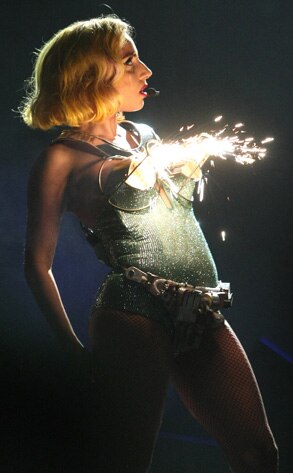
Lady Gaga appears to manifest much of our class’ working definition of what it is to be queer. She simultaneously confronts the male gaze and the gaze of an audience, embodying a female sexuality that dares to look its voyeurs in the face. She often refers to her fans, dubbed “little monsters,” as outsiders, “queer” individuals who don’t fit nicely into heteronormative patriarchal society; her concerts become mass supportive gatherings of self-proclaimed misfits.
Lady Gaga’s upcoming album, entitled Born This Way, and her recent actions and speeches against the US military’s “Don’t Ask, Don’t Tell” policy, situate her amidst a national debate about homosexual status in the US. So yes, queer.
However, as many are offering up the Lady as a shining beacon of homo hope in American popular culture, there are many ways in which Lady Gaga is not queering the institution of celebrity, and is, in fact participating in what queer theorist Devon Carbado would deem discrimination (through a lack of recognition, disavowal, and interrogation of her privilege, seen here). While issues of homosexual identity and visibility are important parts of her public (and private, I would imagine) persona, as queer theorists we realize that this overreliance upon homosexual visibility (the “coming out” story being the cornerstone of said reliance) belongs in the homonormative realm of LGB activism, silencing the voices of QPOC (queer people of color), transgendered folks, poor people, people who are disabled, and, ultimately, queer folks who just don’t necessarily give a shit if they can be openly gay in the military, because they are instead concerned with their physical safety, access to health care, and other basic tenets of human existence denied to them.
But for those outside of the academy, the concept of theory doesn’t really interact with their lives. I had never heard/thought of high theory before I came to college, and I imagine a similar situation exists for others. The concept of celebrity, however, although fleeting or criticized, is one that pervades the lives of most anyone living in the US; it also preoccupies much of the world’s attention outside of US borders. That is, in fact, celebrity by definition: to be known, to be famous, to be someone that strangers will recognize on their digital screens as Important.
Lady Gaga appears to manifest much of our class’ working definition of what it is to be queer. She simultaneously confronts the male gaze and the gaze of an audience, embodying a female sexuality that dares to look its voyeurs in the face. She often refers to her fans, dubbed “little monsters,” as outsiders, “queer” individuals who don’t fit nicely into heteronormative patriarchal society; her concerts become mass supportive gatherings of self-proclaimed misfits.
Lady Gaga’s upcoming album, entitled Born This Way, and her recent actions and speeches against the US military’s “Don’t Ask, Don’t Tell” policy, situate her amidst a national debate about homosexual status in the US. So yes, queer.
However, as many are offering up the Lady as a shining beacon of homo hope in American popular culture, there are many ways in which Lady Gaga is not queering the institution of celebrity, and is, in fact participating in what queer theorist Devon Carbado would deem discrimination (through a lack of recognition, disavowal, and interrogation of her privilege, seen here). While issues of homosexual identity and visibility are important parts of her public (and private, I would imagine) persona, as queer theorists we realize that this overreliance upon homosexual visibility (the “coming out” story being the cornerstone of said reliance) belongs in the homonormative realm of LGB activism, silencing the voices of QPOC (queer people of color), transgendered folks, poor people, people who are disabled, and, ultimately, queer folks who just don’t necessarily give a shit if they can be openly gay in the military, because they are instead concerned with their physical safety, access to health care, and other basic tenets of human existence denied to them.
*photo credit unknown
