Showing posts with label queer theory. Show all posts

Monday, December 6, 2010

Janelle Monáe

Janelle Monáe, producer of thrilling music, great style, and general foxiness, is producing music with themes of anti-oppression and racial and class empowerment; though in some ways she is queering the way black women can perform gender and sexuality in pop culture, her music is not overtly criticizing homophobia or subverting heterosexuality.

Ruth Goldman's “Who is that Queer Queer?” discusses queer theory's tendency to ignore race and class in its project of disrupting heteronormativity, and thus calls for greater attention to race and class. In the case of Janelle Monáe, the marginalization of black and working class people is what she is critiquing. However, despite her displays of open support for the queer community and her habit of leaving her sexual orientation ambiguous (saying in an interview with Rolling Stone that “I only date androids” without specifying who qualifies as an android), some of Monáe's most popular music does not overtly address the oppression of sexual minorities. Thus, Monáe's work in some ways exemplifies Goldman's articulation of the alienation of people of color and working class people from queer theory due to its tendency to universalize the experiences of white, middle-class people and leave out people of color and working-class people.

Monáe is queering a number of things: she performs working class identity and a sort of androgyny by donning a tuxedo, bowtie and saddle shoes, terming it her uniform in homage to her working class roots: “My mother was a janitor and my father collected trash, so I wear a uniform too.” In her song “Many Moons,” she interrupts the song's melodic verses with a spoken litany of often marginalized characteristics or identities (Many Moons: minute 3:39), including 'hood rat,' 'crack whore,' 'closet drunk,' 'outcast,' 'black girl,' 'welfare,' 'HIV,' 'overweight,' 'tomboy,' 'heroin user,' 'coke head,' and 'Jim Crow.' Monáe names these markers of oppression – mostly class- and race-based with brief mention of size oppression and gender identity marginalization (tomboy) – as a call to those whose “freedom is in a bind” to “just come and I'll take you home” to Shangri-La, a mythic utopia. However, in comparison to her overt messages about race and class empowerment, homophobia and oppression based on sexual identity go remarkably unmentioned in this song. It's a bit of a bummer, really, that she doesn't take this opportunity to include a critique of the marginalization of black queer people.

Despite this leaving out of queer people, Janelle Monáe has set up her music, message and aesthetic as a powerful medium of criticism of social and injustices and oppressive systems; she could perhaps quite easily incorporate the oppressions of sexual minorities into this critique. I'm rooting for her, too, because she's already indicated that she supports queer rights, and because her presence on the music scene is so vibrant, thrilling, and powerful that if she gave a critique of sexual and gender normativity, people would listen.

Friday, November 5, 2010

"Monstrous Discrepancies" Comic


This image is a clip of a comic titled "Monstrous Discrepancies" from the "Subnormality" comic blog. Defining sexuality is a problem that often plaques queer theory, but this image provides an accessible way to define sexuality. Sexuality is fluid, not binary. Every different variation of sexuality has a different term (hence the "alphabet soup" phenomenon). This comic simplifies the problem of identifying sexuality with clear imagery. Every monster is a little different from the others, which is similar to sexuality. Everyone's sexuality is a little different, even within identified groups. This comic relates to every article that has tried to define queer and to every article's underlying definition of queer. Some of these articles are "Dueling Dualisms", "Who's That Queer Queer", and "Introduction: Queering Black Studies/'Quaring' Queer Studies."

Tuesday, November 2, 2010

Lady Gaga: Queen of Queer?


Okay, I’m just going to come out (hooray for puns!) and say it: I am not a fan of theory. Reading it is an exercise in frustration, and comprehending it can be a tangled nightmare. Yes, there can be that magic moment, that instant when the clouds part, rays of light illuminate the classroom, and there is an inaudible click when something makes sense. That moment can sing, and reaching that moment of clarity is what draws me back to theory, even when our relationship is frazzled and hanging by a thread.

But for those outside of the academy, the concept of theory doesn’t really interact with their lives. I had never heard/thought of high theory before I came to college, and I imagine a similar situation exists for others. The concept of celebrity, however, although fleeting or criticized, is one that pervades the lives of most anyone living in the US; it also preoccupies much of the world’s attention outside of US borders. That is, in fact, celebrity by definition: to be known, to be famous, to be someone that strangers will recognize on their digital screens as Important.

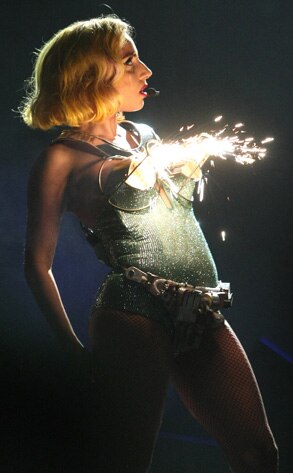
Lady Gaga appears to manifest much of our class’ working definition of what it is to be queer. She simultaneously confronts the male gaze and the gaze of an audience, embodying a female sexuality that dares to look its voyeurs in the face. She often refers to her fans, dubbed “little monsters,” as outsiders, “queer” individuals who don’t fit nicely into heteronormative patriarchal society; her concerts become mass supportive gatherings of self-proclaimed misfits.

Lady Gaga’s upcoming album, entitled Born This Way, and her recent actions and speeches against the US military’s “Don’t Ask, Don’t Tell” policy, situate her amidst a national debate about homosexual status in the US. So yes, queer.

However, as many are offering up the Lady as a shining beacon of homo hope in American popular culture, there are many ways in which Lady Gaga is not queering the institution of celebrity, and is, in fact participating in what queer theorist Devon Carbado would deem discrimination (through a lack of recognition, disavowal, and interrogation of her privilege, seen here). While issues of homosexual identity and visibility are important parts of her public (and private, I would imagine) persona, as queer theorists we realize that this overreliance upon homosexual visibility (the “coming out” story being the cornerstone of said reliance) belongs in the homonormative realm of LGB activism, silencing the voices of QPOC (queer people of color), transgendered folks, poor people, people who are disabled, and, ultimately, queer folks who just don’t necessarily give a shit if they can be openly gay in the military, because they are instead concerned with their physical safety, access to health care, and other basic tenets of human existence denied to them.
*photo credit unknown

Wednesday, October 20, 2010

Wenshu Lee: "Kuaering Queer Theory: My Autocritography and a Race-Conscious, Womanist, Transnational Turn"

What would you do if I called you a kuaer? Say whaaaat? I bet you wouldn't really know what to do, or what to say, because, well, what exactly does that mean? Let me see if I can help.

Wenshu Lee has lives in both Taipei, Taiwan and San Jose, California in the U.S.; she speaks Chinese and English. She is currently a professor at Loyola Marymount in the College of Communication and Fine Arts and a scholar in communication studies and Asian studies. She focuses her scholarship in, among other things, queer/quare/kuaer studies. And she may just identify as kuaer, too. Or at least she did in 2003 when she published the article “Kuaering Queer Theory: My Autocritography and a Race-Conscious, Womanist, Transnational Turn,” the article which is the subject of this blog entry.

I'm sorry... autocritography? I suppose we need to break down her vocabulary. Vocabulary, in fact, is one of Lee's main topics of interest. Autocritography is a technique Lee found in the work of Michael Awkward which she uses to describe her writing style and rhetorical strategy. In each paragraph of this article, Lee divides her narrative voice into two visibly distinct pieces: one version of her voice is italicized, a self-reflective, dreamy, poetic, authentic voice that reads more like prose than 'academic writing.' This voice addresses the reader directly as 'you' and speaks critically and intuitively about herself. The second voice is an academic one, her scholarly voice, through which she presents her research and analysis. These two voices speak to and build on one another. Autocritography is Lee's attempt at “a concrete intercultural communication project” that integrates intersectionality rather than giving it lip service (163). She uses autocritography to act out her commitment to the poetic as well as the personal, political, professional, and scholarly; and she uses it to keep in focus the ways that she is marginalized and privileged because of her specific identity.

So what is Lee studying through this autocritographical essay? She introduces the article with a section titled “...My Nameless Everywhere....” This is the name she gives to a history of omission that she experiences as a Taiwanese woman-identified women who lives and works in the U.S. and China. She's talking about the way that lesbian women of color's real lives are not represented by mainstream culture, and the way she has thus been conditioned to identify herself with the dominant history, to a degree that she feels in many ways identified as a heterosexual white woman, even though she's not. Her whole article is the story of the way that she unburied and found names for her marginalized identities. She has a number of projects that play out from here:

  1. She traces the history of Taiwanese nu nu (female-female) connections and vocabularies from the 19th century to the present – in other words, the way that lesbians and woman-identified women performed their lesbianism and what they called themselves. She traces this history in three sections, each of which she calls an 'awakening' to describe the way that she experienced each discovery – as an awakening to a history she identified with. The first concerns itself with 19th century Chinese nu nu names and women, the second with those of the 1990s, and the third with a term she has invented that builds on these last two vocabularies and integrates it with womanist thought and quare theory.

  2. She integrates this history with womanist and radical women of color traditions and E. Patrick Johnson's quare theory (see Allison's blog entry below) from the United States which have also greatly informed her identity. She gives particular attention to the womanist focus on peoples' specific intersectional experiences of gender and race; she embraces E. Patrick Johnson's notion of quare theory for its critique of queer theory's tendency to erase the importance of race and class in its theory and politics. The integration of these U.S. traditions with her Taiwanese history make her project transnationalist, as does her commitment to formulate a critical praxis in a post-colonial globalized world. People who identify with this movement – these transnational, womanist, quare theory and politics – can now identify as 'kuaers,' the term Lee coins to label her new consciousness. She creates this term through wordplay, which I discuss below. Kuaer is a transliteration of two Chinese characters, kua, which can mean crossing, praised, or proud/boastful, and er which means child/children and “connotes vibrant energy, the ability to grow and to learn new things” (162). Thus kuaer connotes a variety of meanings:

    Children who cross horizons. Children who are praised. Children who are proud/boastful. Children who cross worlds and understand quare and womanist politics. Transnational womanist quare children who are proud and praised and whose critical consciousness is multi-racial, multi-sexual, multi-gendered, and multi-class-based (162).

  3. She examines and practices wordplay as a subversive, creative rhetorical activity. In her second awakening, she discusses the first officially registered lesbian publication in Taiwain, Ai Fu Hao Zi Zai Bao, or Ai Bao, which means “the Love Newspaper/Magazine.” This title in its long version can be read in five different ways using homophonic and homonymic wordplay. She breaks down these five ways of reading it. The first is a reading in which the title is a collection of traditional and gendered Chinese values – “Love, Luck, Good, Self at Ease Newspaper” (155). “Love, Luck, Good” are feminine and selfless values, while “Self at Ease” is masculine and self-oriented (155). Other readings subvert these traditional and gender-appropriate values into phrases which would not be appropriate to talk about in public, let alone publish as a magazine title, such as “Caress/Foreplay, U.S. Sanitary Napkins/So Very Great/Free Newspaper/Magazine” (157). These wordplays are discursively creative and defiant in that they remake traditional values into something new and fresh, and thereby identify the traditional values (which are heteropatriarchal) as cliché by comparison (157). The implication then is that women loving other women are performing acts that are original, creative, and good, thus creating a self-affirming discourse for nu nu women (158). This conception of the usefulness of wordplay as a creative and deviant act becomes relevant for her specific purposes because it underlies the way she has created her new name, kuaer.

So, what do you think? If I call you a kuaer, am I right? And do you like it? As Lee puts it, “do you find kuaer yo yi ci (meaningful; interesting/intriguing; romantically engaging)?

Thursday, October 7, 2010

"A Comparative Analysis of Hijras and Drag Queens" by Sandeep Bakshi


In his article "A Comparative Analysis of Hijras and Drag Queens" Sandeep Bakshi explores the ability of hijras and drag queens to question heteronormative culture. He begins his article by explaining hijras. Hijras are men who voluntarily go through castration and penectomy and thus, are neither men nor women. They perform as women at important Indian ceremonies, such as weddings and birth ceremonies, as "perceived guarantors of fertility" (213). Though they are culturally sanctioned, they are not regarded as full citizens either and have few political rights. Their community structure is very religious (each hijra has guru) and hierarchical, mirroring normative society. Their motivation for castration is part of a religious ritual to a goddess and their history is shrouded in myth. Hijras are similar to drag queens, by virtue that they parade as women, but they are not the same.

Bakshi compares and contrasts the ability of hijras and drag queens to subvert the gender binary and common conceptions of gender roles. Hijras perform in a public space and "enjoy religious and cultural legitimacy" (216), while drag queens perform in a private or alternative space. Hijras interact with the public who tend not to question heteronormative culture, while in most cases drag queens are performing to an audience that is already questioning society. One problem during the performance of hijras is that the gender roles of the audience members are reinforced, because women are passive observers and men are active participants, "controlling" the show. Drag queens also seem to reinforce gender roles because "female impersonators almost universally present stereotypical and exaggerated images of females" (218). Not only that, but power is a fundamental part of current gender dynamics and in one sense male drag queens are proving that they are "'better' women than women themselves" (218), reinforcing male power. A drag queen's performance relies on the audience's preconceived perceptions of gender and gender roles, instead of calling them into question. While both hijras and drag queens perform as women, hijras reveal their sex (or lack thereof) at the end of the show by lifting up their saris. This shocks the audience are destabilizes their experience.

Bakshi finishes his article by reminding the reader to keep national context in mind when comparing and contrasting cultural practices of the Orient and the West. Both hijras and drag queens "are subcultural byproducts of Western and Indian societies and have developed in relation to their respective mainstream cultures" (221). And they both have their limits and abilities to question the gender binary within their respective cultures. In conclusion "reading the hijra alongside the drag queen means broadening and enriching the discursive elements of identity (in)congruity and revealing the fiction of all gendering and sexualizing processes of any dominant culture" (221).